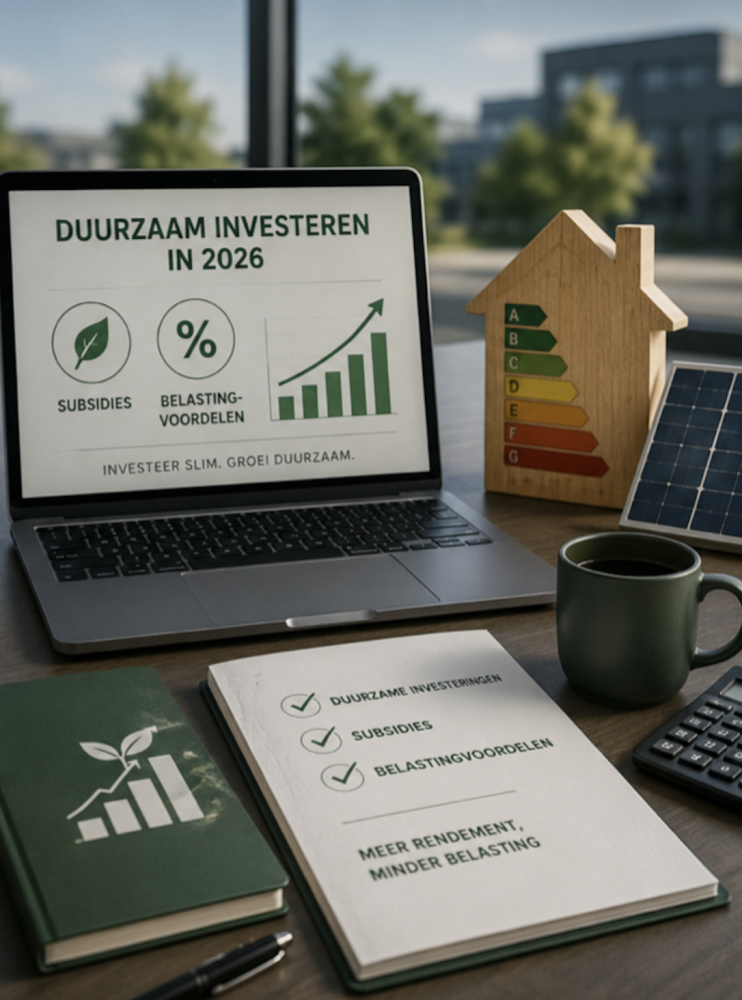
Sustainable investing in 2026
Entrepreneurs, you may benefit from subsidies and tax breaks
Electric company cars, energy-efficient machines or sustainable business premises: more and more entrepreneurs are investing in sustainability. This is not only good for the environment, but can also be financially attractive. In 2026, the government will again offer various subsidies and tax benefits to encourage sustainable entrepreneurship. Would you like to know what opportunities there are for you in the field of sustainability? Then read on.
Why sustainable investing is becoming increasingly important
Sustainability is playing an increasingly important role in the Dutch business community. Customers are more likely to expect companies to do business in an environmentally conscious way, and energy costs also remain an important point of attention. In addition, the government encourages sustainable choices with tax breaks and subsidies.
There are several schemes available for entrepreneurs who invest in energy saving or environmentally friendly business assets. As a result, sustainable investment becomes profitable more quickly in many cases.
Energy Investment Allowance (EIA)
One of the best-known tax benefits in 2026 is the Energy Investment Allowance (EIA). This scheme is intended for entrepreneurs who invest in energy-saving technology, CO2 reduction or sustainable energy. The scheme makes sustainable investments more attractive for companies that want to save on energy costs.
With the EIA, entrepreneurs can deduct 40% of the investment costs from their taxable profit, and therefore pay less tax. There are a number of conditions that you must meet as an entrepreneur if you want to make use of the EIA. For example, the investment must be on the so-called Energy list. This list is updated every year. The minimum investment amount must also be 2500 per business asset and the business asset may not have been used before.
Environmental Investment Allowance (MIA)
In addition to the EIA, there is also the Environmental Investment Allowance Scheme, or MIA. This is aimed at environmentally friendly assets.
The MIA gives entrepreneurs the opportunity to deduct up to 45 percent of an investment from the profit. The exact amount depends on the type of investment and the environmental benefits achieved.
The difference between EIA and MIA is that the EIA is intended to stimulate energy savings and sustainable energy, while MIA is aimed at general environmental friendliness and circular innovation. As with EIA, you can only make use of the scheme if the investment is on a list, in this case the RVO Environmental List.
Arbitrary depreciation of environmental investments (VAMIL)
With the VAMIL scheme, entrepreneurs can depreciate up to 75 percent of an investment at an accelerated rate. This creates a liquidity advantage: companies pay less tax in the year of investment. The VAMIL scheme – like the MIA – also relates to general environmental friendliness and circular innovation, and this scheme also uses the RVO's environmental list.
The difference between the two schemes is that with the MIA there is an extra deduction (less tax) and with the Vamil there is a liquidity advantage (accelerated depreciation). In other words; MIA relates to the amount of the deduction, Vamil to the timing of the deduction.
Important conditions for entrepreneurs
Entrepreneurs must take into account a number of conditions. For example, an investment must usually be registered with the Netherlands Enterprise Agency (RVO). In addition, an entrepreneur may not use both the EIA and the MIA for the same business asset at the same time. It is therefore important to determine in advance under which category the investment will yield the most benefit for your company.
It is also important to check carefully whether an investment is actually on the Energy or Environmental List. Without inclusion on these lists, there will be no fiscal benefit.
Sustainable investment yields more than fiscal benefits
More and more entrepreneurs see sustainability not only as an obligation, but also as an opportunity. Lower energy costs, a better image and future regulations play a major role in this. Moreover, customers and clients increasingly expect companies to work sustainably.
The government is actively trying to accelerate this development with subsidies and tax benefits. In 2026, a large budget has been made available. According to RVO, the total budget for MIA and Vamil together amounts to 155 million euros.
Want to know more?
Are you curious about how you can use the above schemes to make your company more sustainable? Please feel free to contact us, we are always happy to help.
Want to read more? You can find information about the EIA and the. MIA/VAMIL. on the site of the Tax and Customs Administration. More information from the RVO about climate, sustainability and energy can be found here.